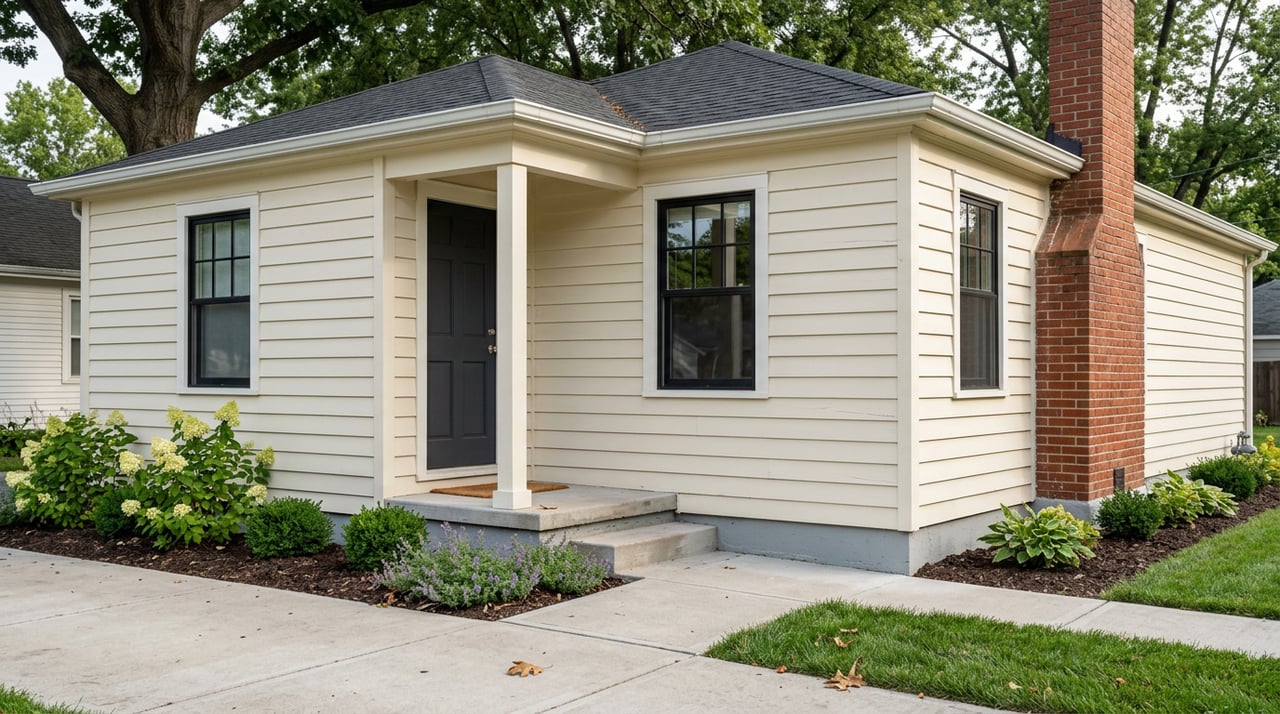
The West Des Moines median sale price sat at $328,000 over the three months ending May 2026, and the citywide average in July drifted around $360,000. Neither number tells you what is happening on 4th, 5th, and 6th Streets in Valley Junction, where a two-bedroom bungalow behind Holiday Park and a rowhome pitched for the same block are now competing for the same dirt.
If you are shopping the sub-$300K end of West Des Moines, this is the sub-market where your offer strategy needs the most local reading. The headline median is a citywide blend of Jordan Creek new builds and 1940s cottages. Valley Junction is the cottage side of that blend, and its pricing floor is being lifted by a policy conversation most buyers never see.
The thesis, in one sentence
Whether a Valley Junction parcel sits inside a proposed transition zone or outside it is quietly becoming a bigger price variable than square footage.
That is the question a buyer should be asking on every showing in the district. Not "what did the last one sell for," but "is this block on the map."
What a "transition zone" actually is
Since 2022, West Des Moines has been extending the Valley Junction master plan from the commercial core out into the surrounding residential blocks. City staff have proposed rezoning five residential areas near the business district to allow what they call "middle housing," meaning townhomes, duplexes, and small mixed-use, alongside boutiques, salons, and studios.
The specific parcels under study are narrow and worth memorizing if you are house-hunting here:
- 5th Street between Vine and Locust
- 6th Street between Locust and Walnut
- Parts of 4th Street between Walnut and Railroad Avenue
Ryan Moffatt, the city's economic development director, has said there is demand for that middle-housing product. Councilman Kevin L. Trevillyan, who represents Valley Junction, has argued the opposite pressure: that rezoning could reduce the supply of the district's most affordable single-family homes. Both are describing the same mechanism from different sides. Land inside a transition zone is worth more to a developer than a single 1,300-square-foot ranch is worth to a family, so the highest and best use of the parcel shifts.
For a buyer, that shift shows up as a bidding floor. A tired cottage on a study-area block is no longer priced against comparable cottages. It is priced against what a developer would pay to assemble.
The Longest Yard tell
The clearest precedent in the neighborhood is not residential at all. It is the site at 122 Fifth Street where the Longest Yard bar stood until it was razed in 2024. The West Des Moines City Council approved a development agreement with restaurant developer Tom Baldwin, with the new building designed by Knop Killeen Architects, and the city attached a ten-year, 100 percent tax increment finance package plus assistance from its Property Improvement Fund and Regulatory Compliance Fund.
Read that as a signal, not a story. The city is willing to underwrite redevelopment inside the historic district when the concept meets the design guidelines. That posture does not stop at commercial. The same appetite is what is now being tested on the residential blocks a few hundred feet away, where developer Ryan Wiederstein of WB Realty Co. floated a 12-unit rowhome proposal to replace three rental homes on 4th Street. That specific proposal drew organized pushback, including yard signs reading "No apartments on 4th," and a community session at the Valley Junction Activity Center at 217 5th Street. The Historic Valley Junction Commercial District itself contains 53 contributing historic properties as of 2025, which sets the design bar any new construction has to clear.
The takeaway for a buyer is not whether the 4th Street project happens. It is that the willingness to entertain it has already been demonstrated on Fifth.
What the summer 2026 street work is telling the market
Public spending is a leading indicator. Per the City of West Des Moines Engineering Services updates dated July 1, 2026, roadway improvements have been completed on 5th Street in Valley Junction, at the 4th Street and Walnut Street intersection, on South 50th Street between Wistful Vista and Mills Civic, and on Mills Civic Parkway from I-35 to South 50th. Phase 10 of the alley reconstruction program is paving the 200 blocks between 2nd–3rd, 7th–8th, and 8th–9th Streets, in residential zones the city has ranked Priority 2.
Alleys sound like housekeeping. They are not, in a neighborhood where garages open onto them and where lot access is a redevelopment prerequisite. Paved alleys with recent storm-sewer work raise the ceiling on what a small parcel can support.
Add the Raccoon River Park north access road reopening and the Scenic Valley Park trail connection scheduled for completion in fall 2026, and you have a district the city is actively upgrading around, not just inside.
Where this leaves the buyer math
The metrowide picture from DMAAR MLS data for July 2026, covering Polk, Dallas, and Warren counties, showed 739 closings against 3,505 active listings, roughly 4.1 months of inventory. The under-$350K band is tighter, closer to 3.6 months, and 61 percent of July closings went pending within 30 days of listing.
Valley Junction is almost entirely in that under-$350K band. Which means two things are true at the same time:
- Competition for the actual house is high, because entry-level inventory is thin metrowide.
- Competition for the underlying lot is asymmetric, because on some blocks a developer is a live bidder and on others they are not.
That is the mechanism that a citywide median cannot show you.
How to read a Valley Junction listing differently
If you are writing an offer on a house between roughly Railroad Avenue and Locust Street, three questions matter more than they would elsewhere in West Des Moines.
- Is the parcel inside a proposed transition-zone study area? The three corridors above are the ones to check against the address. A "yes" changes both your ceiling and your competition.
- What is the lot's assemblage potential? Two adjacent tired homes on 4th Street are a different product than one tired home mid-block. The WB Realty proposal was three homes stitched together.
- What did the seller pay, and when? Owners who bought before the 2022 master plan work started are sitting on land appreciation that has nothing to do with the house. Sellers who bought after tend to price closer to redevelopment value.
None of this is a reason to avoid the district. It is one of the few walkable, sub-median pockets left inside West Des Moines proper, and the infrastructure spend and the Baldwin restaurant project suggest the city is investing in its long arc. It is a reason to price the specific parcel, not the neighborhood average.
A quick FAQ
Does a transition-zone designation mean my house could be taken? No. The proposed zoning changes would allow additional uses on a voluntary basis. Nothing in the current proposal compels a sale or a teardown. What it changes is what a future buyer, including a developer, is willing to offer.
If I buy inside a study area, can I still remodel a single-family home? The city's stated intent is to preserve single-family use as one option within the transition zones, alongside row houses, duplexes, and small commercial. Design guidelines drawn from the Valley Junction Commercial Historic District inform new construction inside the district. Confirm current allowances with the City of West Des Moines Community and Economic Development office before you plan a major addition.
Is Valley Junction really cheaper than the rest of West Des Moines? On a per-house basis, yes. The housing stock skews smaller and older than the Jordan Creek and Mills Civic corridors, which pulls the entry point down. On a per-square-foot or per-lot basis in the study-area blocks, that gap is narrowing, which is the whole point of the thesis above.
How fast are homes moving here? The DMAAR July 2026 metro read was 61 percent of closings pending within 30 days in the under-$350K band. Valley Junction sits inside that band, so plan on tight timelines and be prepared to write on the first weekend.
If you are shopping this district
The value in Valley Junction is real, and so is the friction. Pricing a home here means pricing the block, the alley, the master-plan map, and the calendar of city council decisions, not just the comps within a quarter mile. That is exactly the kind of read where a local advocate earns their fee.
If you want a parcel-level opinion on a specific Valley Junction address, or a comparison against a similar-priced home outside the study areas, BVZ Homes is happy to walk it with you and put the numbers side by side. Contact us when you are ready to move from "browsing" to "writing."