If you have been looking at Waukee and wondering why so much of it still feels brand new, you are not imagining it. This is a city growing fast, with new neighborhoods, fresh inventory, and active development still shaping what buyers see from one area to the next. If you want to understand how Waukee’s newer neighborhoods differ, what price points to expect, and what to watch for before you buy, this guide will help you sort through it with more confidence. Let’s dive in.
Why Waukee Still Feels New
Waukee has grown at a pace that stands out even in a busy metro. Census QuickFacts estimates the city had 34,890 residents on July 1, 2025, which is a 45.7% increase from April 1, 2020. That growth is much higher than nearby West Des Moines, Urbandale, and Clive over the same period.
That kind of jump helps explain why Waukee often feels different from older suburbs. In many parts of the city, you are not just buying into an established pattern. You are buying into a place that is still actively expanding, planning, and building.
The city’s 2025-2026 Strategic Priorities also show that growth is still very much in motion. Waukee has identified the need to update its Comprehensive Plan and continues to focus on development along the Kettlestone corridor south of Ashworth Road and north of I-80. That tells you newer housing here is often part of larger district planning, not just scattered infill.
Construction activity supports that picture. The city reported 196 building permits in April 2026 and 182 in May 2026, including single-family homes and townhomes. For buyers, that means new options are still entering the market, and the city’s newer-home story is ongoing.
What Newer Neighborhoods Look Like
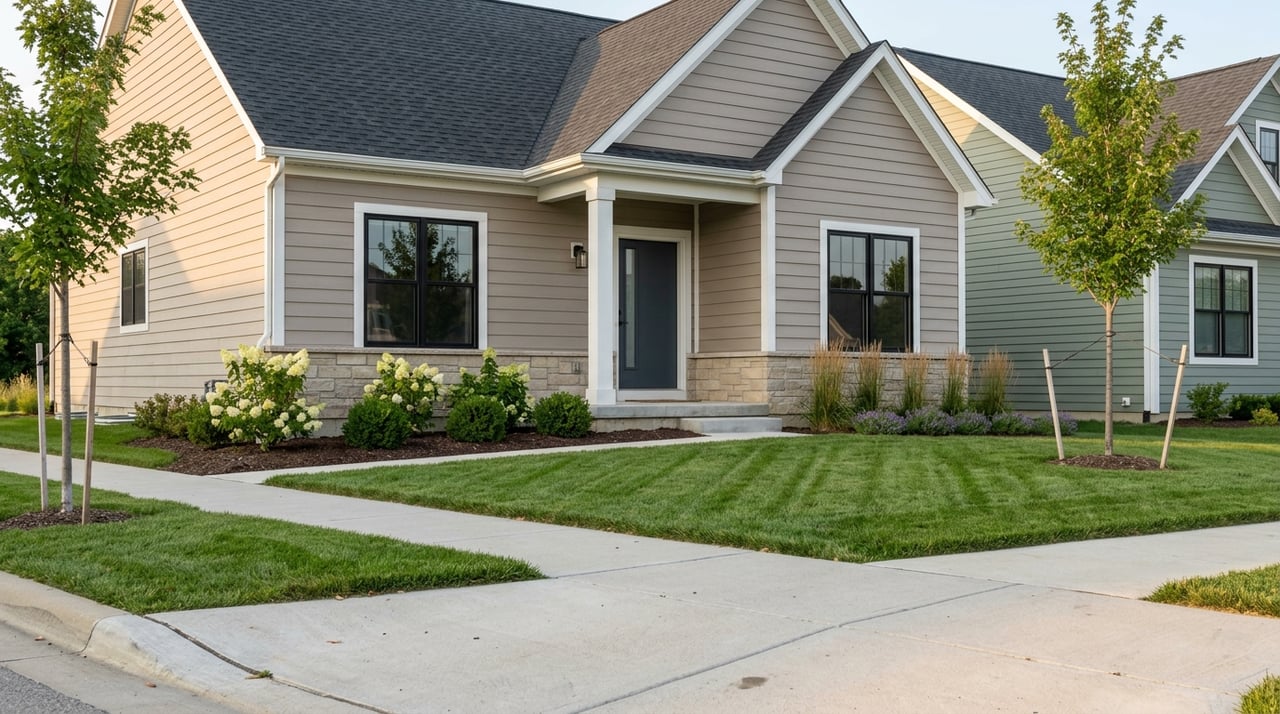
One of the most important things to know about Waukee is that newer construction is not all the same. Some neighborhoods follow a more traditional suburban pattern with detached homes on larger lots. Others are designed for more compact living, including townhomes, row homes, and smaller-lot detached homes.
According to Waukee’s Neighborhood Design Guidelines, traditional low-density residential areas usually have lots from about 8,000 square feet to 0.50 acres, with average densities of 2 to 4 units per acre. Medium-density areas are where side-by-side townhomes, row homes, and small-lot detached homes fit best, at roughly 4 to 12 units per acre.
Inside Kettlestone, the form can be even more compact. The row-house and townhome district allows no minimum lot area or width, expects two- to three-story buildings, calls for front porches, and encourages rear-loaded garages. In practical terms, that means your idea of a “new Waukee neighborhood” could range from a classic suburban street to a more walkable, attached-home setting.
Real project examples show that range clearly. A city staff report for Maple Grove Place described a detached-townhome project with 83 lots ranging from 4,950 to 9,920 square feet. By contrast, Castle Ranch is shown as a newer development with 20 lots ranging from 10,795 to 21,415 square feet.
Common Home Styles in Newer Waukee
Across current communities, a few home-style patterns show up again and again. Ranch plans and two-story homes are common, and open-concept layouts are a frequent selling point. That matches what many buyers want today: flexible gathering space, efficient layouts, and room to grow.
Fox Creek Meadows offers homes from 1,105 to 1,994 square feet with 2 to 5 bedrooms and 2 to 3.5 baths. Fox Valley ranges from 1,516 to 2,402 square feet, also with a mix of ranch and two-story designs. Autumn Valley markets ranch and two-story plans starting at 1,498 square feet and above.
Some newer product includes more upgraded or expanded features as well. Stratford Crossing’s Horton Series is described as offering ranch-style homes with open-concept layouts, finished basements, and three-car garages. For you as a buyer, this means Waukee offers a wide spread of house types even within newer construction.
What Buyers Can Expect on Price
Waukee’s newer-home market covers a broad range, which is part of its appeal. You can find smaller-footprint new builds and entry-level options in the low-to-mid $300,000s, move-up detached homes in the mid-$400,000s, and custom or upper-end homes into the $800,000s.
That range gives buyers more ways to stay in the same suburb while changing the type of home they target. If you are comparing a townhome-style setup, a practical detached first home, or a larger move-up property, Waukee gives you multiple lanes to explore.
Here are a few examples from current community and listing snapshots:
- Autumn Valley is listed around $330,000 to $370,000
- Fox Creek Meadows starts at $352,100
- Fox Valley starts at $443,900
- Custom-home listings in Waukee are shown around $825,000 to $840,000
- Castle Ranch lot-only inventory starts around $140,000 to $171,000 for buyers exploring lot purchase and future build options
Homes.com also describes Waukee’s new-construction market as having 30 new-home communities. That is a marketplace snapshot rather than a city statistic, but it still helps show how much selection buyers may be sorting through.
Why Amenities Matter in Newer Areas
In Waukee, the neighborhood experience often matters almost as much as the home itself. The city says it offers 25 miles of trails and 22 parks and trailside amenities, with the trail system designed to connect neighborhoods. That connectivity can shape your daily routine, from evening walks to easier access to parks and recreation.
Triumph Park is one of the biggest examples. The city describes it as a 66-acre regional facility with 12 baseball and softball fields, 3 miles of trails, a 15,000-square-foot inclusive playground, and an 11-acre pond with accessible fishing. If you are comparing newer neighborhoods, nearby access to established amenities like this can be a meaningful value point.
Kettlestone also adds to the broader appeal. The city describes Keetown Loop as its premier entertainment district, while Kettlestone Central and Kettlestone Lakes are planned around recreation, dining, retail, office, and entertainment uses. For buyers, that means some newer neighborhoods are tied not just to housing growth, but to a larger mixed-use vision.
The Trade-Offs Buyers Should Know
Newer neighborhoods can be exciting, but they also come with moving parts. In a fast-growing city like Waukee, open land near your home may not stay open. Nearby parcels can become future townhomes, apartments, offices, retail, or additional single-family phases as the city continues to develop.
That does not make a newer area a poor choice. It simply means you should go in with clear eyes. A view you like today, a quiet road pattern, or the amount of nearby construction activity may look different a few years from now.
Traffic is another practical factor. As neighborhoods fill in and commercial areas expand, vehicle patterns can change. If you are buying in a still-developing section of Waukee, it helps to think beyond the home itself and consider what the surrounding area may look like after more phases are complete.
How to Judge Long-Term Fit
When you tour newer neighborhoods, try to think about both your current needs and your likely resale position later. Homes that are already tied into completed trails, parks, shopping areas, and established streets may feel more settled than homes at the edge of active construction. That can matter for both your day-to-day comfort and future buyer appeal.
It also helps to compare not just the house, but the specific stage of the neighborhood. Two homes with similar square footage and price points can offer very different experiences if one is surrounded by completed infrastructure and the other is still next to dirt work and future phases.
A few smart questions to keep in mind include:
- How much nearby land is still undeveloped?
- Are trails, parks, and road connections already finished?
- Is the area mostly detached homes, or is a broader mix of townhomes and multifamily planned nearby?
- Does the layout match how you want to live now?
- Will the home still make sense for you in three to five years?
A Simple Way to Shop Waukee New Construction
Because Waukee has such a wide spread of newer-home options, it helps to narrow your search by lifestyle first. Start by deciding whether you want lower-maintenance living, a standard suburban lot, or a larger lot or custom-home path. That one step can quickly eliminate neighborhoods that are not the right fit.
Next, line up your budget with the type of product you are actually seeing in the market. If your comfort zone is in the mid-$300,000s, your options may look very different from someone shopping in the mid-$400,000s or above. Knowing that early saves time and keeps expectations realistic.
Finally, pay close attention to the area around the home. In Waukee, the difference between a good fit and a great fit often comes down to location within the city, access to trails and parks, and how much change is still coming nearby.
If you want help comparing Waukee’s newer neighborhoods, sorting through new-construction options, or narrowing down the best fit for your budget and goals, BVZ Homes can help you make sense of the choices with clear, local guidance.
FAQs
What makes Waukee different from nearby suburbs for buyers?
- Waukee has grown much faster in recent years than several nearby suburbs, which gives it a stronger new-construction feel and a larger pipeline of newer neighborhoods and active development.
What kinds of homes are common in newer Waukee neighborhoods?
- Buyers will often see ranch homes, two-story homes, townhomes, row homes, and open-concept layouts, with options ranging from compact attached housing to larger detached homes on traditional lots.
What price range should buyers expect in newer Waukee communities?
- Current examples show newer-home options starting in the low-to-mid $300,000s, move-up homes in the mid-$400,000s, and custom or upper-end homes reaching into the $800,000s.
What should buyers watch for in fast-growing Waukee areas?
- Buyers should pay attention to nearby undeveloped land, future construction phases, changing traffic patterns, and whether trails, parks, roads, and surrounding amenities are already completed.
Are all newer Waukee neighborhoods built the same way?
- No. Waukee’s newer housing ranges from traditional low-density neighborhoods with larger lots to more compact townhome and row-house districts, especially in planned areas such as Kettlestone.
Why do amenities matter when buying in newer Waukee neighborhoods?
- Amenities such as trails, parks, and mixed-use areas can shape daily convenience, neighborhood feel, and long-term appeal, especially in a city where many newer communities are still taking shape.